
“The best way to find yourself is to lose yourself in the service of others.” -Mahatma Gandhi
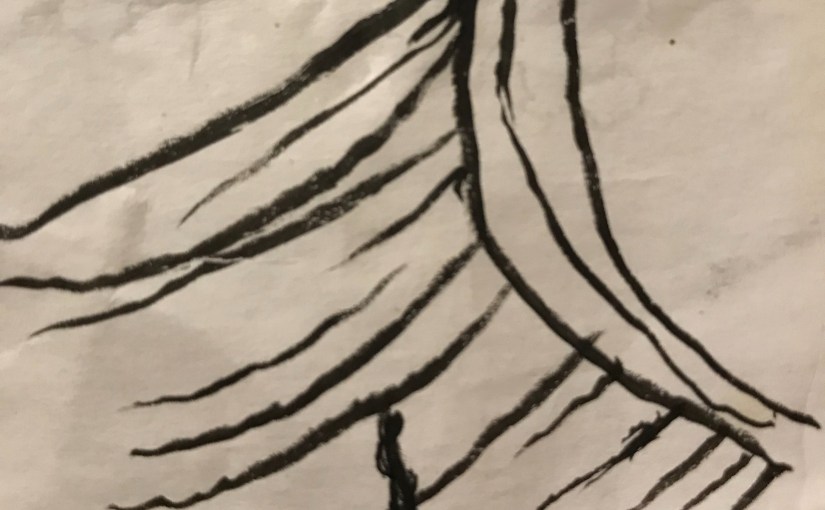
We are all on a journey of self-discovery that feels at times, like this sketch, where a lone traveler walks an unknown climbing terrain seemingly to nowhere.
However, it is in our relationships with others where we are driven to look within, to become our best self, and to reveal our own truth.
The source of our desire is love.
In loving service to others we can discover ourselves as we do not really “lose” ourself in service, we find it, as it is reflected in those we serve.
—
This is where my instagram post ended but I want to expand on ideas mentioned in this post further. Here I am starting with the general notion of ‘finding yourself’ and in later posts I’ll discuss more about love and service.
—
The idea of ‘finding yourself’ as we traditionally conceive of it, such as the lone traveler who ‘finds themselves’ on their journey through mere self-reflection, is a bit misleading.
Yes, inner reflection and contemplation is absolutely a part of the process. But it is not the only part of what is necessary for true self-discovery.
You are, in large part, a reflection of and co-creation with everyone who has been a part of your life. You cannot truly sever who you are from these relationships be they great or small.
Think of your family of origin, for instance. Some of your first self-concepts were generated from your relationships with the people who raised you. In your family you were taught their idea of what it means to be a person either explicitly, by telling you directly, or simply via their example and interactions with you.
Let’s say that when you were growing up you saw your mother and father work all day at jobs they did not love. You internalize, at least to some extent, that working is an important part of what it means to be a functional person in the world and that enjoying your job is not as important. Your parents may have even directly told you that “You need to work to make a living and contribute to society”.
Self-reflection is the means by which you can not only discover your internalized values and beliefs but also decide whether they are values and beliefs you want to truly embrace.
Let’s go back to our example. Through self-reflection, you can come to an understanding that the ‘Working is important but enjoying your work is not important’ concept was modeled to you by your family. Then, once you have brought this into your awareness, you can intentionally decide whether you want to reject or accept this family modeling that was given to you.
Maybe you feel that working is still important to you but you also feel that it is important to love the work that you do. However, you’ve noticed you feel guilty every time you try to leave your current job that you don’t enjoy to pursue work you love. This can be due to a conflict between what you were raised to believe versus what you have come to believe in time through other personal experiences.
The solution? First, you need to discover that you have this conflict of values and beliefs and then you need to consciously choose the belief that is in alignment with what you truly value.
In our example, you would need to realize that you do not identify with what you were raised to believe: ‘Working is important but enjoying your work is not important’ . Then you need to embrace and consciously choose the belief and act from the belief that is in alignment with your values: ‘Working is important but enjoying your work is also important’.
In some ways it really is this simple but old beliefs and values can be resilient since through time they become habitual and internalized. Changing your beliefs to be more in alignment with your values is a process. The more ingrained the belief, the more patient and compassionate you need to be with yourself to support yourself to forge a new path and way of being.
Finding yourself is a process of coming to understand yourself, what you value and believe. But it is also a process of understanding all of the people and relationships in your life and how they have all been a part of who you have been, who you think you are, and who you are becoming. Finding you is finding others.
Becoming a better person in this way is finding the best part of you and others that you have internalized within yourself and choosing from all the beliefs and values you have been given what you truly want to be and become.

 Ethical Living